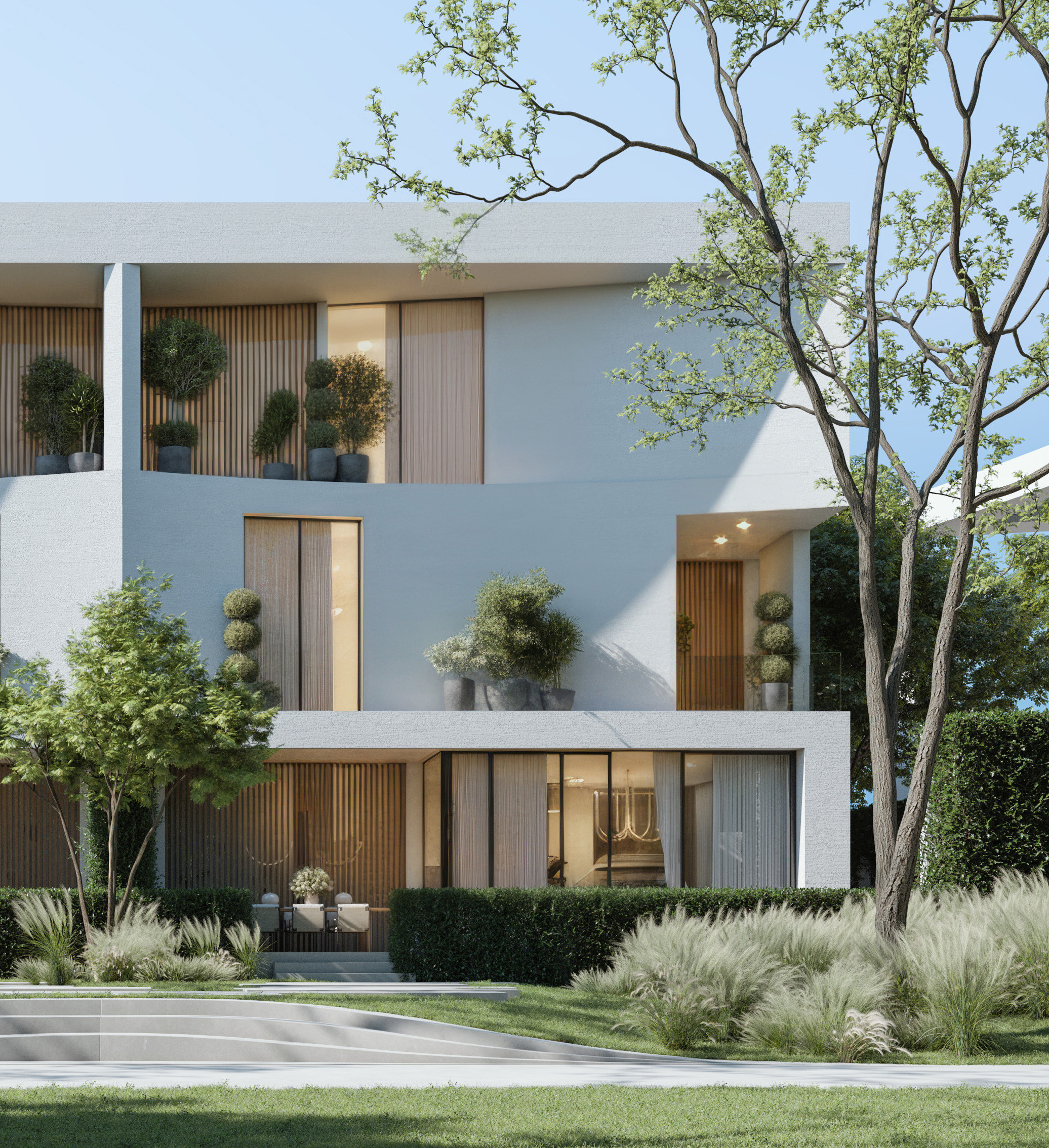
Off-plan villas in Dubai: the rare opportunity Lunaya represents
The Dubai off-plan market is dominated by apartments. In any given quarter, the city launches dozens of apartment buildings, from compact studios in Jumeirah Village Circle to ultra-prime towers in Downtown. Off-plan villa launches are a different category, an order of magnitude rarer, and they behave differently in terms of price formation, demand and resale dynamics. Lunaya is one of the few legitimate off-plan villa communities of the 2026 cycle, and understanding why that rarity matters is one of the most important steps for a potential buyer.
Why apartment launches outnumber villa launches
The structural reason is land economics. An apartment tower on a small plot produces hundreds of sellable units. A villa community on the same plot produces a few dozen. The developer math favours apartments at every metric: revenue per square metre of land, speed of sale, repeatability of layout, construction cost predictability. Villas need more land, more landscaping, more infrastructure per unit, and they sell to a different buyer profile that demands more customisation.
The second reason is land availability. Land suitable for premium villa communities, large enough for a real master plan, well located against the main corridors, with proper utility connections, is rare in Dubai and getting rarer. Most of the historic villa land bank has been built out. New villa communities now require either deep-pocket master developers or strategic partnerships that few players can execute. The Lunaya plot in Saih Shuaib 1 belongs to that scarce category.
Why rarity creates pre-handover appreciation
The economic consequence of villa-launch scarcity is well documented in Dubai market data. When a serious off-plan villa community comes to market in a strong segment, the pre-handover price curve tends to be steeper than that of apartments in the same area. The reason is supply: there are simply not many villa alternatives to substitute, so demand concentrates on the few projects that exist. Buyers who arrive at launch capture the early phase of that price formation.
The Dubai prime cycle of 2022 to 2026 has shown villa pre-handover appreciation that, on multiple benchmarks, has exceeded 8 percent compounded annually, with select villa communities significantly above. For an off-plan buyer, the gap between the launch price and the secondary-market price at handover is often the largest component of the total return. Lunaya is positioned in a corridor where that gap has historically been strong, with the SZR location, the Jebel Ali transformation and the ZAYA Living delivery track record working in its favour.
What buyers should know about the payment plan
Lunaya offers a 40/60 construction-linked payment plan: 40 percent paid during the construction phase against verifiable construction milestones, and 60 percent settled at handover. This structure has three practical consequences for buyers. The first is capital efficiency: the buyer is exposed to the full appreciation of the asset while having committed only 40 percent of the price during construction. The second is risk alignment: payments are tied to construction progress, not to calendar arbitrary dates, which provides better protection against schedule slippage.
The third consequence is resale flexibility. Lunaya allows resale during construction (subject to standard developer conditions), which gives a buyer the option to exit before handover if circumstances change. Combined with the appreciation pattern that off-plan villa launches typically produce, that flexibility transforms the asset from a single-exit purchase into a portfolio position with multiple decision points. The detailed mechanics are explained on lunaya-by-zaya.ae.
The Golden Visa angle
Beyond the financial dynamics, Lunaya unit purchases qualify for the Dubai Golden Visa, the ten-year renewable residency tied to qualifying real estate investments. For international buyers, that adds a non-financial benefit that materially changes the calculation. The villa is not only an asset and a residence, it is also the legal anchor of a long-term residency permit for the buyer and dependents.
Combined with the UAE tax regime (zero personal income tax, zero capital gains tax on individual sales), the freehold ownership for foreigners and the relative stability of the AED to USD peg, the Lunaya off-plan purchase aggregates several layers of optionality that are difficult to replicate in other prime global markets. For an international buyer arbitrating between London, Paris, Lisbon, Miami and Dubai, that combination is one of the strongest arguments in favour of allocating to the Dubai segment in 2026.
What a buyer should remember
Off-plan villa launches in Dubai are structurally rare and that rarity drives appreciation and resale dynamics. Lunaya is one of the few legitimate villa launches of the current cycle, with a credible developer, a strong location and a 40/60 payment structure that aligns risk and capital efficiency. For a buyer with a 24 to 36-month horizon, that combination represents one of the better-defined off-plan villa opportunities available in Dubai today.